

As the editor-in-chief of the national standard for public broadcasting, the networked public broadcasting system independently developed by DSPPA is a two-way audio amplification system based on pure digital technology transmission. It combines the independent DSPPA protocol and the standard TCP/IP protocol to transmit audio signals in the form of data packets on the LAN and WAN. The delay time in the LAN does not exceed 100ms, and it has functions such as sound repair and automatic flow adjustment, which completely solves the problems of poor sound quality, limited transmission distance, lack of interaction, and complex maintenance and management of traditional broadcasting systems. The system is built in an industry-innovative modular layered manner, with obvious advantages such as high integration and intelligence, simple and user-friendly operation. Audio acquisition, telephone paging, fire linkage, monitoring and other functions can be inserted in the back of the host in the form of a board, or installed in any network-accessible place in the LAN. The network expansion module makes function customization more flexible and maintenance more convenient. The system can use the existing LAN architecture to realize the integration of computer networks, digital video surveillance, public broadcasting and other networks. The transmission distance can reach more than ten kilometers, and the construction is fast, saving investment. It breaks through the pattern of traditional public broadcasting that can only be transmitted and can only be centrally controlled by the central machine room, and has powerful interactive functions. The system digitally encodes the analog audio signal and transmits it on the network platform, which not only realizes the functions of the traditional broadcasting system, but also overcomes the shortcomings of traditional broadcasting such as line impedance, power, voltage, short transmission distance, and poor system scalability, making the sound clearer and more stable. When the system transmits programs, each program occupies only 0.1Mbps of bandwidth. In a LAN with a bandwidth of 100Mbps, 300 completely different programs can be played to 300 network terminals at the same time, and the volume of 300 network terminals can be independently controlled. The system also has powerful functions such as real-time broadcasting, scheduled broadcasting, zone broadcasting, group broadcasting, telephone broadcasting, free on-demand, real-time broadcasting, paging intercom, fire linkage, one-button alarm, power control, forced output, output monitoring, on-site monitoring, program recording, secondary development, log query, software upgrade, priority setting, etc. The sound quality output by the system network terminal is close to CD level (48K, 16bit), with clear and beautiful sound quality, which can meet the requirements of background music appreciation and school listening examinations. The system server adopts the enterprise-level standard server working mode, the system service runs in the background, and the system runs automatically when it is turned on. At the same time, it adopts hot backup master-slave design, supports automatic detection and switching, the network terminal has its own SD card storage, supports scheduled automatic backup, and the system terminal is compatible with analog 100V backup, ensuring the system's uninterrupted, safe and stable operation 24 hours a day.
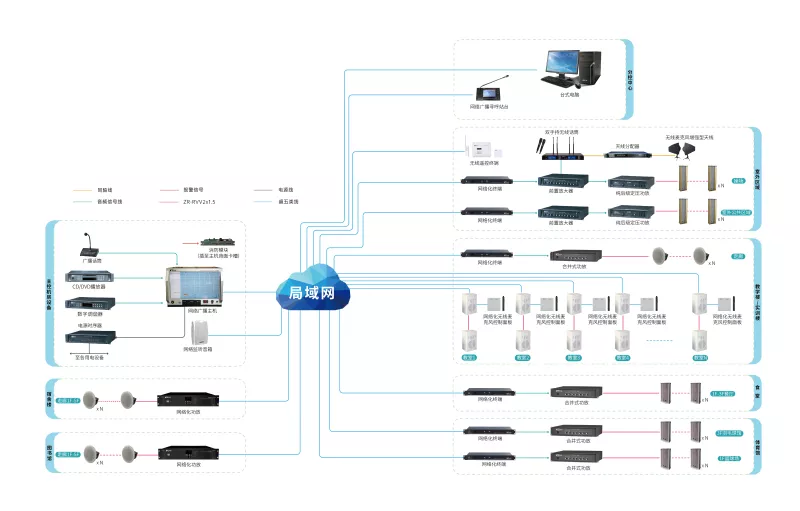
The system server adopts modular design. Functional modules such as audio acquisition, telephone paging, fire linkage, power management, monitoring, etc. can be inserted in the back of the server in the form of boards, or network expansion modules and functional modules can be installed in any network-accessible place in the LAN, making server function customization more flexible, operation more convenient, and maintenance more convenient;
The system digitally encodes the analog audio signal and transmits it on the network platform, avoiding the signal attenuation and noise of the traditional broadcasting system, ensuring high-fidelity sound quality, and overcoming the problems of limited transmission distance, lack of interaction, and complex maintenance and management of the traditional broadcasting system;
After the system terminal equipment is online, the IP address of each device terminal can be fixed on the server, and the specific device name can be noted, and the broadcast volume, paging volume and alarm volume of each device terminal can be adjusted separately;
The system provides a humanized graphical menu interface, with a 17.3-inch full HD LCD touch screen, supports wireless mouse, keyboard and other peripheral control, which is convenient and practical, meets more customer usage needs, and supports system timed power on and off without manual operation;
The system can realize the timed broadcast function through programming, and can play any program at any time in any partition. The program volume can be adjusted, which truly realizes the system automatic broadcast and unattended operation;
The system can use the existing LAN architecture to divide a VLAN for the broadcast system and specify the terminal IP address, so as to realize the multi-network integration of computer network, digital video surveillance, public broadcasting and other networks, and the construction is simple and fast;
The system application function has a large number of intelligent designs, terminal equipment display intelligent sorting, equipment terminal IP address batch modification, timed task remote editing and uploading, outdoor wireless remote control to play host program, built-in speakers for program preview, etc.
Including business speech broadcasting, background music, timed ringing and radio relay, etc.;
Through the server or IP network paging microphone, you can make any broadcast call to a single, local area or all network terminals;
The system can set any number of groups, play designated programs, and broadcast speeches to any designated group;
The system will realize full-automatic broadcasting at a fixed time and fixed point according to the task plan;
Through the operation of the remote control or the device panel buttons, you can realize any on-demand program in the server music library;
The external sound source is connected to the audio acquisition terminal, and the real-time acquisition and compression into high-quality data streams are sent through the network. The network adapter receives and plays in real time, which is used for inserting external program broadcasts and broadcast notifications, etc.;
The network adapter is connected to an external or panel built-in pickup, and the sound around the location of the network terminal can be monitored in the main control room.